Published Aug. 15, 2024
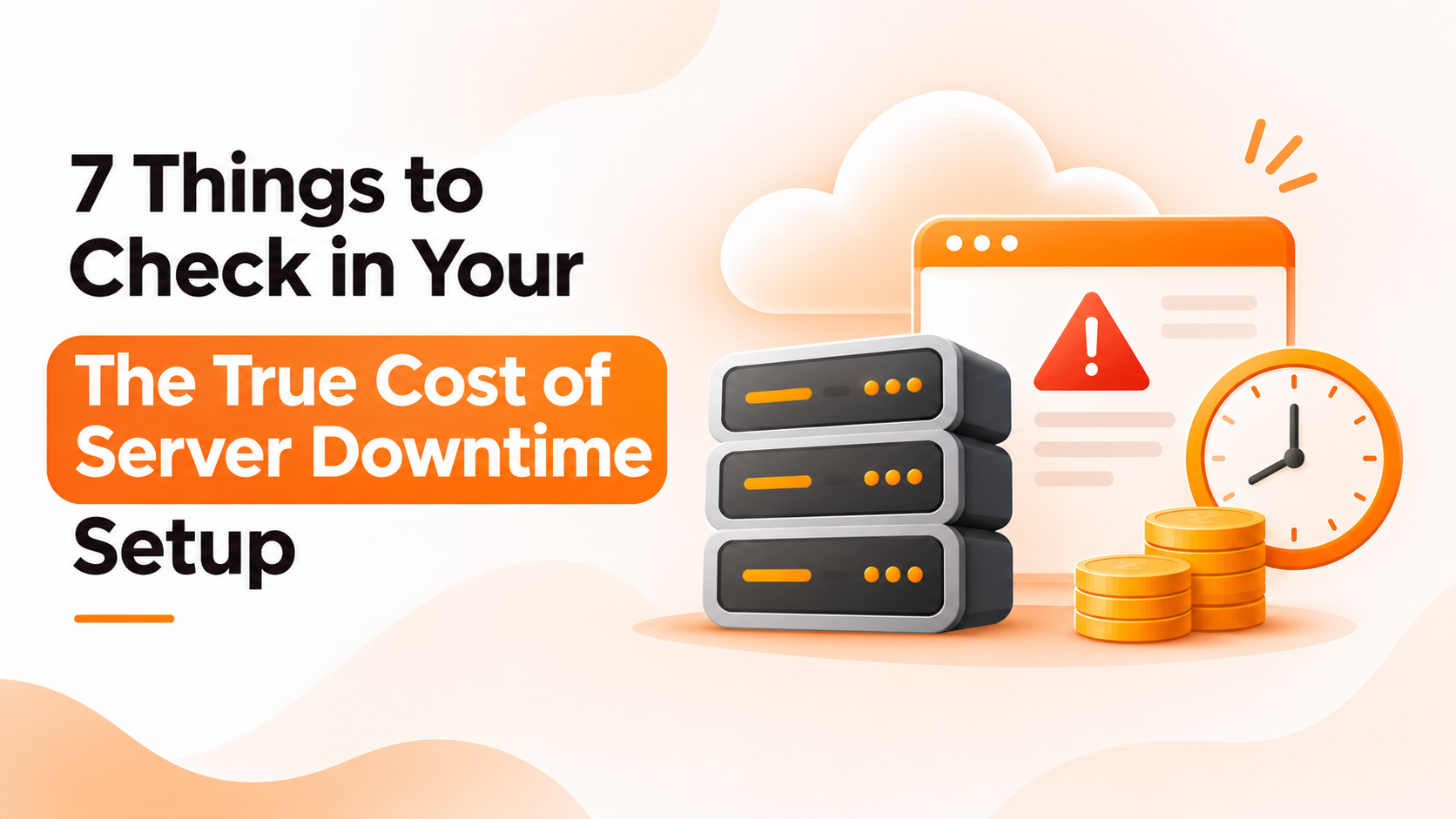
Most teams can quote an uptime percentage, but few have actually added up what an hour of downtime costs them beyond the obvious. The cost of downtime isn't just the minutes a server was unreachable — it's lost transactions, wasted engineering time, slower recovery, and a dent in customer trust that doesn't show up on any status page.
This list breaks down seven real costs worth checking against your own setup, so the next outage is measured by more than just how long it lasted, and so the business case for fixing monitoring gaps is based on something more concrete than a gut feeling.
Every minute a customer-facing service is down is a minute of transactions, signups, or orders that simply don't happen. For any business where revenue depends on the site working, this is the most direct and easiest cost to calculate — and usually still an undercount, since it only reflects what happened during the outage, not what it took to get back on track.
An unplanned outage pulls engineers away from planned work, often several of them at once. That diverted time is a real cost even when the incident itself is resolved quickly, and it rarely shows up anywhere except a missed sprint.
Without a clear signal pointing to the cause, every incident starts as a guessing exercise. The longer it takes to identify what actually broke, the longer the outage runs — and the cost scales directly with that time, often faster than people expect once an incident passes a certain length.
A customer who hits an error once might shrug it off. A customer who hits it twice starts looking elsewhere. Trust lost during downtime is rarely regained by the fix alone — it takes a track record of reliability afterward.
An outage noticed publicly — on social media, a status page, or word of mouth — costs more than the incident itself. It shapes how prospective customers perceive reliability before they've even tried the product.
An outage that gets patched without being properly understood tends to come back. Each repeat occurrence compounds the original cost, since the underlying issue was never actually fixed.
The most expensive version of any outage is the one your own monitoring didn't catch first. Finding out from a customer instead of an alert adds the time it took them to notice, report it, and wait for a response — all before anyone even starts fixing it, and it tells that customer their experience wasn't being watched at all.
The monitoring setup that actually reduces these costs is the one that catches a problem before a customer does, tells you enough to diagnose it quickly, and gets the alert to the right person without delay. A tool that only confirms a server is "up" or "down" won't help much with any of these — it needs to track response time, distinguish the type of failure, and give your team an actual starting point for diagnosis.
It's also worth checking whether alerts reach a channel your team actually watches, and whether a brief, resolved blip gets treated differently from a sustained outage. A setup that pages people for noise trains them to react slower to the incidents that matter, which quietly reintroduces several of the costs above even after the tooling is in place.
BigBell's monitoring is built around catching problems before they become costly outages. URL monitoring checks uptime and response time from outside your infrastructure, the way a real customer would reach it, and distinguishes the type of failure — a connection error, a timeout, or an SSL problem — rather than reporting a flat "down," so your team starts diagnosis with real information instead of a guess.
SSL certificate expiry is tracked on its own schedule, catching one of the most preventable outage causes before it happens. Thresholds are set per server or application, a configurable delay filters out noise so the team isn't desensitized to real alerts, and a recovery notification confirms once things are back to normal. Alerts reach your team through email, Slack, Microsoft Teams, Google Chat, WhatsApp, SMS, or a phone call, routed to whoever actually owns the resource rather than a shared inbox.
Try BigBell free and see what it takes to catch the next outage before it gets expensive.
Why is the cost of downtime usually underestimated? Because most teams only count the obvious part — lost revenue during the outage — and skip the engineering time, slower diagnosis, and trust impact that follow it.
Does a faster fix reduce the overall cost of an outage? Yes, significantly. The longer an outage runs, the more each of these costs compounds, so anything that shortens detection and diagnosis time directly reduces total cost.
Is reputational damage really a measurable cost? It's harder to measure directly, but it shows up later as hesitation from prospective customers or churn from existing ones who experienced the outage, often well after the incident itself is forgotten internally.
What's the single most effective way to lower downtime costs? Catching the issue before a customer does. Every other cost on this list gets worse the longer an outage runs undetected by your own systems, since detection time is usually the single biggest variable in how expensive an incident ends up being.
Do repeat incidents cost more than a single long outage? Often, yes. Each recurrence adds its own diagnosis time and trust impact, and a pattern of repeat incidents damages confidence more than one isolated outage, since it signals that the underlying cause was never actually addressed.
Can better monitoring alone prevent all downtime costs? No. Monitoring reduces detection and diagnosis time, which lowers several of these costs significantly, but it doesn't eliminate the underlying causes of outages on its own.
Should small teams worry about the cost of downtime as much as larger companies? Yes, often more so. A small team usually has less slack to absorb an outage's cost, and early customers are often less forgiving of a rough experience than an established user base would be.
How does SSL certificate expiry fit into the cost of downtime? It's one of the more avoidable causes, since it happens on a predictable date rather than from unexpected load or a bug. An outage caused by an expired certificate is entirely preventable with a check that catches it in advance.
Does the cost of downtime scale the same way for every business? No. A business where revenue depends directly on the site working, like e-commerce, feels the direct revenue cost faster than one where downtime mainly affects internal productivity, though the trust and reputational costs apply broadly either way, regardless of how directly revenue is tied to uptime.