Published Dec. 25, 2024
A security report lands in March. It lists a dozen findings, the team fixes most of them by May, and everyone relaxes until the next audit. Meanwhile, engineers keep launching servers, changing rules, and adding users every week. By the time the next report arrives, the cloud environment looks very different from the one that was tested.
That gap is why many teams ask about continuous VAPT for cloud accounts. This guide compares periodic VAPT with more frequent checking, and explains where Bigbell fits. The first sections are general industry knowledge. The last section covers only what Bigbell provides, and it is not a VAPT service.
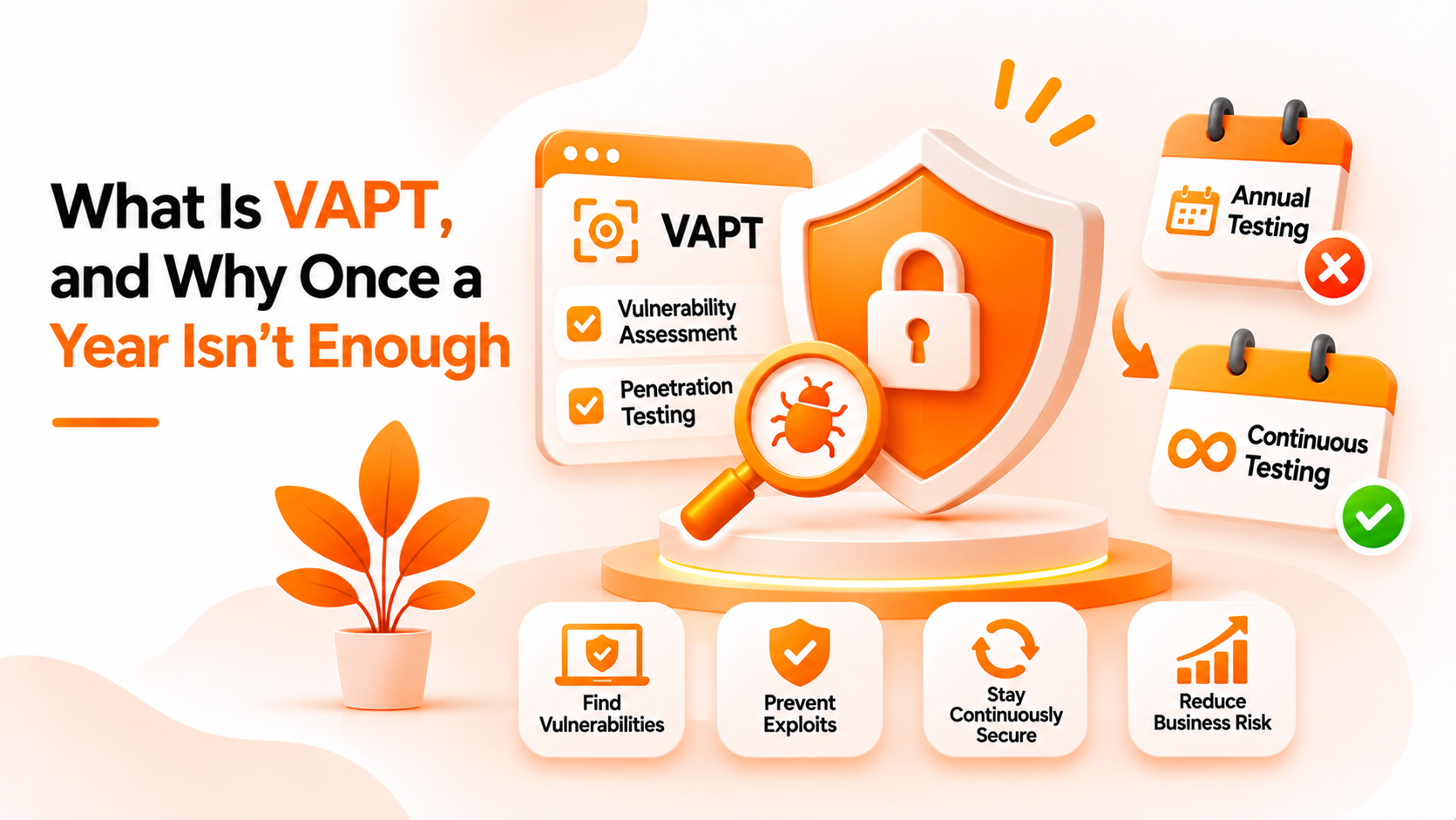
VAPT stands for vulnerability assessment and penetration testing. A vulnerability assessment looks for known weaknesses, such as outdated software or risky settings. Penetration testing goes further: a skilled tester tries to exploit weaknesses the way an attacker would, to show what is truly reachable and what damage it could cause.
Most organizations run VAPT on a schedule, often once a year, or before a major launch. Many compliance and customer requirements ask for it. The strengths are real. A human tester can chain small issues together, find logic flaws that tools miss, and explain the business impact in a way an automated list cannot.
The weakness is timing. A report describes one moment. Anything that changes afterwards, a new public server, a loosened firewall rule, a user without protection, is outside its view until the next engagement. Penetration tests also cost time and money, which is why they are rarely repeated monthly.
The second approach runs lighter checks far more often. Instead of a person testing attack paths, software inspects the cloud account for known risky conditions: services reachable from the internet, missing protections, users without extra sign in safeguards, and similar patterns. Results arrive as a list of findings to review and fix.
The strength is coverage over time. New risks show up soon after they are created, and small problems are fixed before they grow. The effort per run is low, so teams can run checks after big changes or on a regular rhythm.
The limit is depth. Automated checks look for specific conditions they were built to find. They do not think like an attacker, they miss business logic problems, and they cannot prove that a weakness is exploitable. A clean result means those checks passed, not that the environment is secure.
| What matters | Periodic VAPT (Option A) | Frequent automated checks (Option B) |
|---|---|---|
| Depth | Human testers find what tools miss and show real impact | Limited to the conditions checked |
| Frequency | Often once a year | As often as needed |
| Cost per run | High | Low |
| Compliance evidence | Usually stronger; often named in requirements | Supporting only |
| False confidence risk | A clean report can hide recent changes | A clean scan can hide issues outside its checks |
You do not have to choose one. The practical answer for most teams is both. Use scheduled penetration testing for depth and compliance, and use frequent checks to catch everyday drift between tests.
If budget allows only one, decide what you are protecting against. If the main worry is an attacker finding a creative path into a critical application, invest in testing. If the main worry is simple mistakes piling up, such as an exposed database port, frequent checks give faster value.
Whichever you pick, set an owner for the findings. A report nobody acts on is the same as no report.
Bigbell does not provide VAPT. It does not perform penetration testing, and it should not be treated as a vulnerability management or compliance product.
What it offers is the Option B style of checking. The Cloud Security Scanner connects to AWS, Azure, or Google Cloud accounts that you add, and you start scans from Bigbell. Bigbell keeps the scan history, so you can review results over time. Findings include a severity, the affected resources, and a recommended next action.
The conditions it reports are specific. For ports, it flags sensitive ports such as 22, 3389, 3306, 5432, 27017, and 6379 as high severity, and lists other open ports at low severity. For AWS and Microsoft Entra users, it lists users without MFA and highlights those with console access. It also reports missing backups, databases and servers without deletion protection, RDS databases without Multi-AZ, and certificate expiry for monitored websites.
Be clear about the limits. Scans start when someone starts them, so this is not real time monitoring, and we have not verified an automatic scan schedule. Bigbell does not exploit weaknesses, test applications, or fix findings for you. It does not produce compliance reports or certify anything. It reports a defined set of checks, not every possible vulnerability. Use it to catch drift between formal tests, not to replace them.
Book a demo to see how scanner findings appear for your cloud accounts.
What does VAPT stand for? Vulnerability assessment and penetration testing.
What is the difference between the two parts? An assessment finds known weaknesses. Penetration testing tries to exploit them to show real impact.
How often should VAPT be done? At least annually and after major changes, though your compliance requirements may set the pace.
Is an automated scan the same as VAPT? No. A scan checks for known conditions. It does not simulate an attacker.
Does Bigbell perform penetration testing? No. Bigbell's scanner reports findings from a defined set of checks.
Which clouds does Bigbell's scanner connect to? AWS, Azure, and Google Cloud accounts that you add.
Does Bigbell keep past scan results? Yes. It retains scan history so you can review earlier results.
Does Bigbell fix issues automatically? No. It provides recommendations, and your team makes the changes.
Can Bigbell scan on a schedule? We have not verified a scan schedule, so treat scans as started on demand.
Does Bigbell provide compliance reports? No. It does not produce compliance certification or reports.
Does a clean scan mean I am secure? No. It means the checked conditions passed.
What should I do with findings? Assign an owner, fix the highest severity first, and rescan to confirm.
Why do compliance programs ask for penetration testing? Because a human tester shows whether weaknesses can really be exploited, which a list of findings cannot prove.
What changes in a cloud account between tests? New servers, firewall rules, users, and databases appear, and each can introduce a risk the last report never saw.
Who should review scanner findings? The engineers who own the affected resources, with a security lead tracking the highest severity items.
Can frequent checks replace an annual test? No. They catch everyday drift, while a penetration test provides depth and independent assurance.
How do I decide what to fix first? Start with high severity items on resources reachable from the internet, then work down.
Is VAPT only for large companies? No. Any team holding sensitive data can benefit, though scope and cost should match the risk.